This is not to say I haven’t been gaining a lot of extraordinary skills that will serve me well, but I’m tired. Working retail during the holidays can sometimes be the equivalent of letting someone stab you in the stomach with a hot poker, smiling while thanking them for this and still asking them to come back again. Having this kind of day and then coming home to homework assignments has not been my favorite experience this month. However, it has not stopped me from learning the practical steps towards the rabbit hole that is Place Branding (and I still have faith in humanity so that’s also a plus).
In this month’s course we learned the behind-the-scenes work involved in creating a brand for, or rebranding, a neighborhood or location in our cities. For my project, I chose the Meridian Street North area in Huntsville, AL. The assignment was to research the area’s current identity in the eyes of the residents to form a more positive image for our location’s brand. Needless to say, this took me beyond just Google searching information about my location and straight into the community itself…
Why Meridian Street North
The assignment suggested choosing an area that was close by as we would need to visit it during the course of the project. After careful consideration, I chose Meridian Street North because it is close to where I grew up, from what I remember, it’s always been kind of ambiguous due to business opening and closing over the years and there not being a prominent college campus feel surrounding the schools in the area. It is a low-income, majority Black area that does not have a great representation, due to the abundance of shootings and heavy cop presence through the years. However, Meridian Street North is unique because there are four educational institutions on this one street.
Within a 3-mile radius sits (in order of appearance coming from Winchester Ave.) Alabama Agricultural and Mechanical (A&M) University, J.F. Drake State Community & Technical College, Martin Luther King Jr. Elementary School, and Lee High School. Imagine being able to complete majority of your life’s formal education on one street. This may not be everyone’s dream, but for some people this could be ideal. The area is special and for this multi-course project, I want to use it as a base for learning to bring distinction to an area that deserves more positive recognition.
Connecting/Synthesizing/Transforming
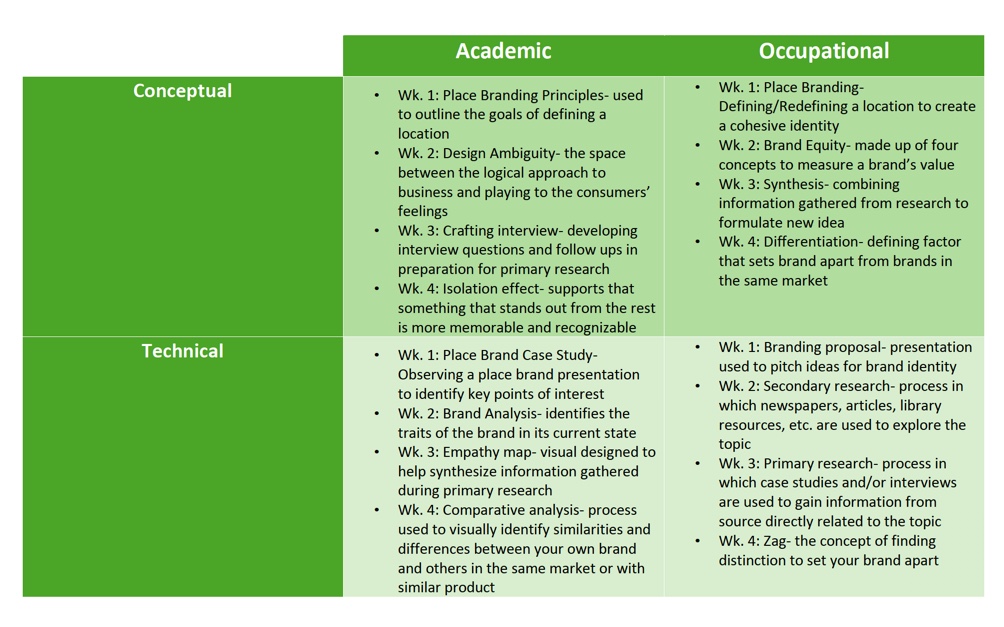
To start, we delved into Primary and Secondary research as necessary steps in the design process. Despite their names, Secondary research is typically the first task completed, in which internet searches, library records, journal articles and other forms of indirect information can be used as an introduction to the desired topic (Argo, 2019; Schwanbeck & Acayo, 2015). Using Secondary sources of information can help formulate a direction that leads to the Primary sources whether that be people who is directly related to the topic or in my case, people directly connected to Meridian Street North–residents, students, businesses, etc.
My Secondary Research
I tried to look up Meridian Street North, itself, as well as the history of the schools on the street. Although I could not find information on when Meridian Street was established, I was able to start with the history of Alabama A&M (n.d.). It is a HBCU and land-grant instituation in Normal, AL that was founded by William Hooper Councill, a former slave and teacher who also served as the school’s first principal (1875-1887; 1888-1890) and president (1890-1909; Blue, 2008). It was originally located in Downtown Huntsville and was intended to teach Black teachers to work in the segregated school system before growing into a “vocational-technical training facility” (Blue, 2008, para. 5) that rivaled Tuskegee. It then changed gears to train Black people in agriculture and the mechanical arts (City of Huntsville, n.d.).
In 1891, when the school received its land-grant, it was relocated to Normal, AL in it’s current location on Meridian Street North (AAMU, n.d.). It wasn’t until 1961 that Joseph Fanning Drake State Technical and Community College took up residence down the street from A&M on land deeded by the University (J.F. Drake State Community and Technical College; Drake, n.d.). Drake was also intended to support the Black community by providing two-year technical degrees in areas such as cosmetology, auto mechanics, masonry, etc. Today, the programs extend to computer information systems, electrical engineering and other associate degrees to meet Huntsville’s growing demand for Technology graduates (Drake, n.d.). This leads to Martin Luther King, Jr. Elementary (n.d.) which opened in 1967 adjacent from an open field down the street from Drake. And lastly, Lee High School (n.d.) which was originally a few blocks from Meridian Street North, but was relocated to its current location in 2010.
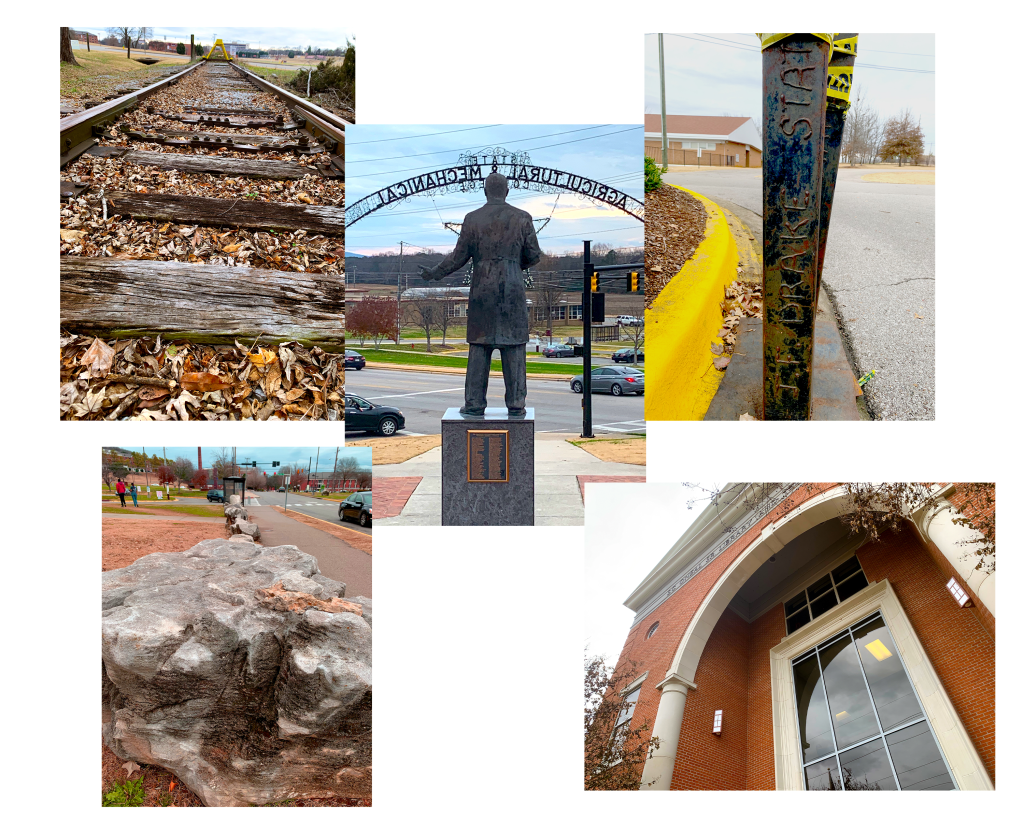
In addition to the history lesson, I also had to get pictures of the area that will be used as inspiration for my design later in the process.
My Primary Research
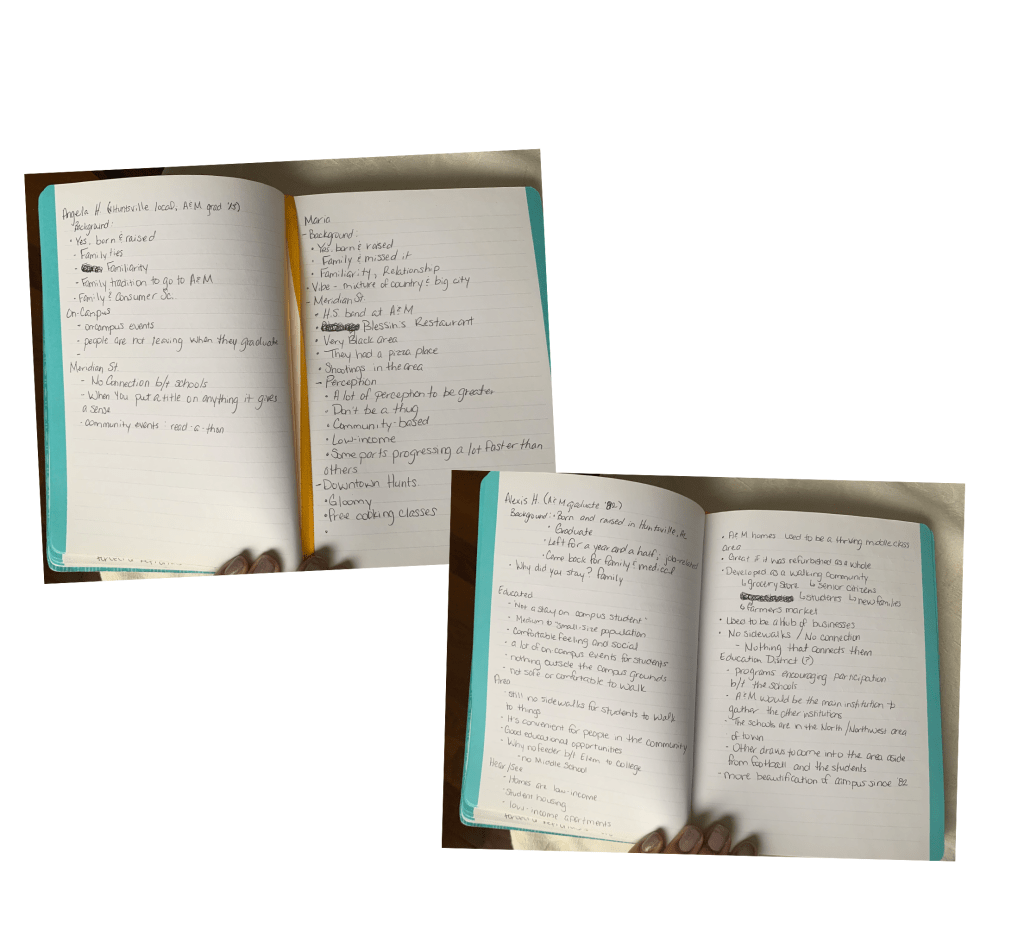
Now that I’d gathered everything I could about schools, it was time to begin my Primary research and speak to individuals with some knowledge and/or connection to the area. Due to time constraints, I was only able to interview three women native to Huntsville with connections to Meridian Street North. Given they are natives of the area, I expected them to know all the good and bad of the area such as its history of violent incidents that have taken place there.
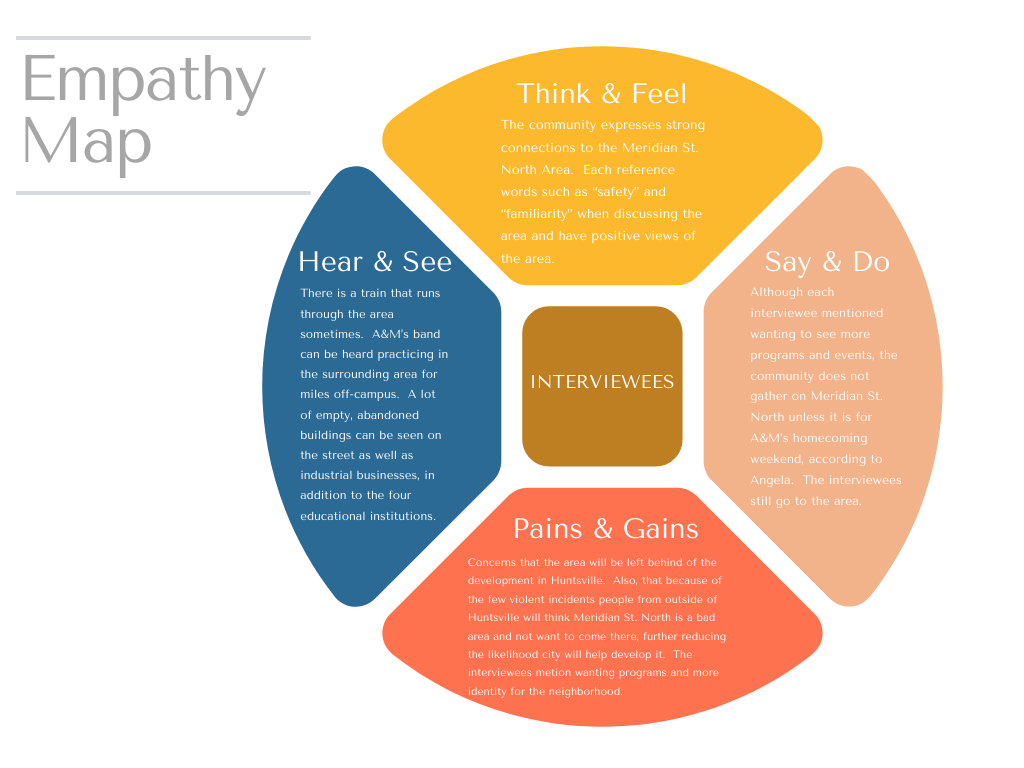
Both, Alexis and Angela (personal communications, December 13, 2019) were graduates of A&M, class of ’82 and class of ’13, respectively. Maria was not a graduate of A&M, but often went to Meridian Street with her mother to eat at Blessin Restaurant in the Meridian Plaza and had friends who attended school at A&M and Drake. Given the knowledge of the area’s history of shootings and fights, I was suprised to find that each of the interrviewees described the area as “safe” and “comfortable feeling” (Alexis H., Angela H., & Maria B., personal communications, December 13, 2019).
There was expression of optimistic views for programs to be implemented between the schools to bring connection to the educational institutions and hope that the City of Huntsville will make an effort to invest in Meridian Street North as much as it does the Entertainment District and majority White areas. The resounding feeling that putting an identity to Meridian Street North can bring direction and a sense of pride to this area that has long been dedicated to empowering this African American community through education.
Although I believed the Meridian Street area could be viewed as an Education District or Learning District, the combined agreement of the interviewees helped solidify this design approach. Of course, there may be people in the area who may not have shared the same experiences and would have varying opinions on the area and its direction. There is a unique vibe to Huntsville as it is growing to become a city heavy with Engineering and Technology jobs to fill the growing number of military and government contractor positions in this area. Areas are being built up, renovated and redesignated for entertainment and business all over the city. Each of the schools on Meridian Street North have also updated their curriculum and direction to help support Huntsville’s growth.
Problem Solving
One of my biggest issues during this design proces was developing the interview questions. Coming up with how to take the information I’d gained and ask someone without feeding them answers was fairly difficult. Schwanbeck and Acayo (2015) noted that it can be difficult moving from Secondary to Primary research when you collected an overwhelming amount of information.
My only options were: 1. Draft specific questions to steer my interviewees into the topic, or 2. Write minimal questions and allow small interjections that stem from the person to steer the conversation. Utimately, I went with Option 2, as it allowed the interview to feel more conversational and not like an interrogation. This allowed me to get honest information from each interviewee on their thoughts and feelings of the area as well as their connection.
Innovative Thinking
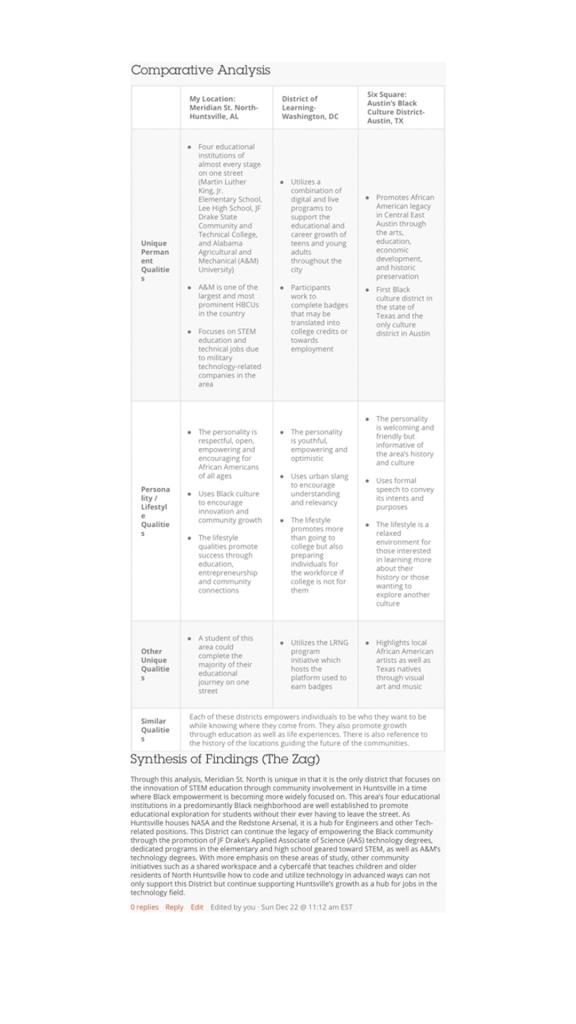
While completing my comparative analysis, it was difficult to find any Education Districts that weren’t just school systems. To help set Meridian Street North apart, I was forced to use other terms such as the Learning District and the STEM District to help with the search. When using this term, I found that Washington, DC is developing a program to rebrand the city as the District of Learning. However, in Huntsville, there is no known Learning District nor is there a STEM District that I was able to find during my search. The STEM District could be an accurate name for the area as the schools provide programs and clubs that support STEM education. With more community-based programs and groups or businesses such as cybercafes and shared spaces, this could grow into a STEM-focused neighborhood.
Acquiring Competencies
In Conclusion…
References:
Alabama A&M University (AAMU). (n.d.). Our history. Retrieved from https://www.aamu.edu/about/our-history/index.html
Argo, B. (2019, December 02). Week 2 live session [Online video]. Retrieved from https://online.fullsail.edu/class_sections/46808/modules/201234/activities/1241030
Blue, C. (2008, June 1). William Hooper Councill (1849-1909). Retrieved from https://www.blackpast.org/african-american-history/councill-william-hooper-1849-1909/
City of Huntsville. (n.d.). Alabama A&M University (Original Site). Retrieved from https://www.huntsvilleal.gov/historicmarkers/alabama-university-original-site/
J.F. Drake State Community and Technical College. (n.d.). Mission & history. Retrieved from https://www.drakestate.edu/about-drake-state/mission-history
Lee High School. (n.d.). School history. Retrieved from https://www.huntsvillecityschools.org/schools/lee-high-school/schoolhistory
Martin Luther King, Jr. Elementary. (n.d.) Martin Luther King, Jr. Elementary. Retrieved from https://www.huntsvillecityschools.org/schools/martin-luther-king-jr-elementary/martin-luther-king-jr-elementary
Schwanbeck, A. & Acayo, P. (2015, February 24). Learning design research [Lynda.com course]. Retrieved from https://www.linkedin.com/learning/learning-design-research/primary-vs-secondary-research?u=50813145

