This month has been a whirlwind of new experiences and challenges. This class has presented me with new insights not only about myself but about my skills as a designer. One thing I’ve learned is that I need more structure than I thought when it comes to how my days are set up and the ways I prepare myself to create. As a retail worker, it is difficult for me to lock down any sort of pattern or schedule to study or mentally prepare for school work when I have to work 12p-9p one day and then 10a-9p the next then MAYBE have the day off afterward. It’s not impossible, just harder.
On the other hand, I have found that completing tasks such as logo design are not beyond my capabilities. I would definitely have to hone my skills and learn more about the technical approaches to logo design and typography, but I did it! I was actually quite proud of myself in the end even though I would constantly develop artist blocks and felt like I was being raked over coals when I couldn’t imagine creating one more design idea. I may not foresee a future in logo design, but it’s not outside my scope of abilities.
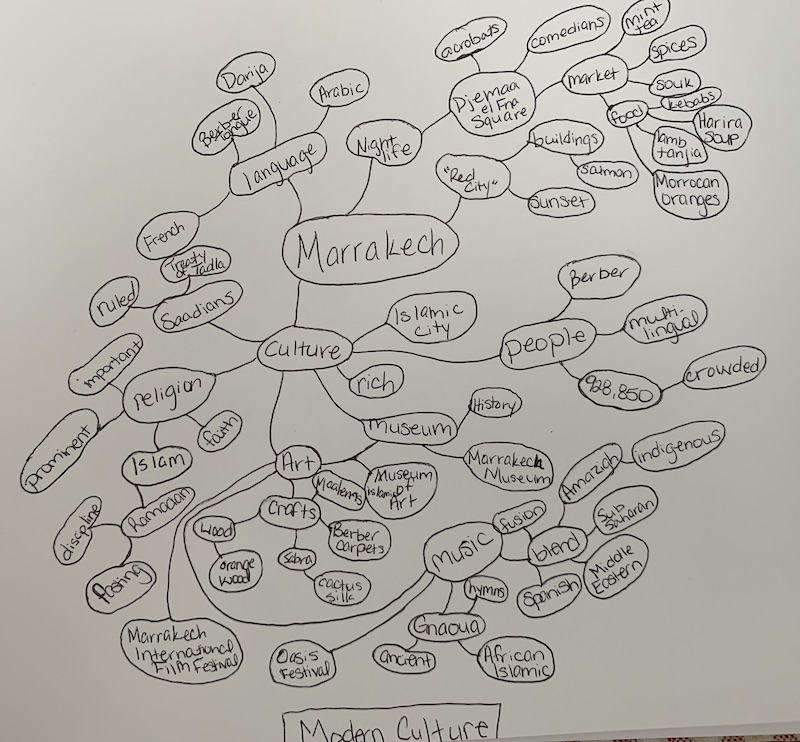
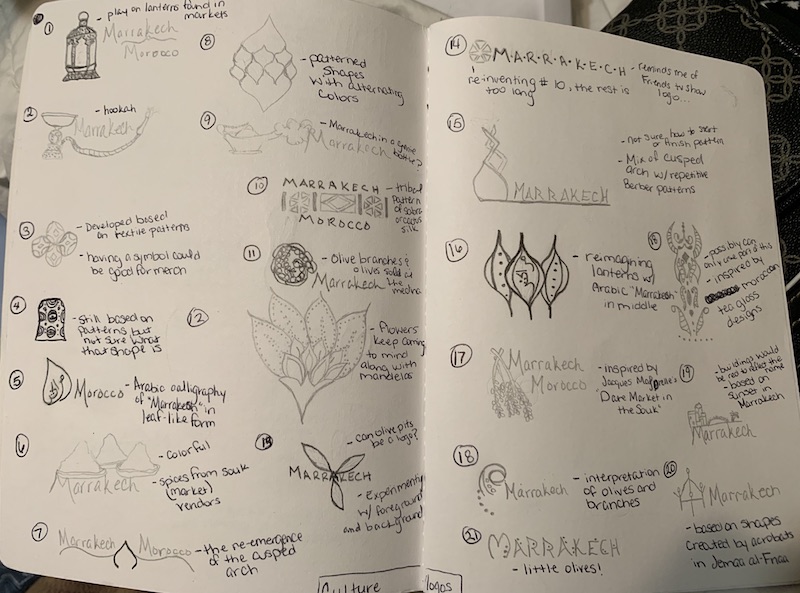
For this assignment, I needed to look at two diagrams created by O’Grady and O’Grady (2009) and choose the one that closest resembled the approach I took when completing the initial stages of logo design–mind mapping and sketching. Initially, the idea of designing logos was extremely daunting. Having the assignment broken down throughout the course definitely helped. I naturally gravitated to conducting research, creating prototypes, and then assessing my work before going back to do more research–as displayed in the following diagram (O’Grady & O’Grady, 2009).
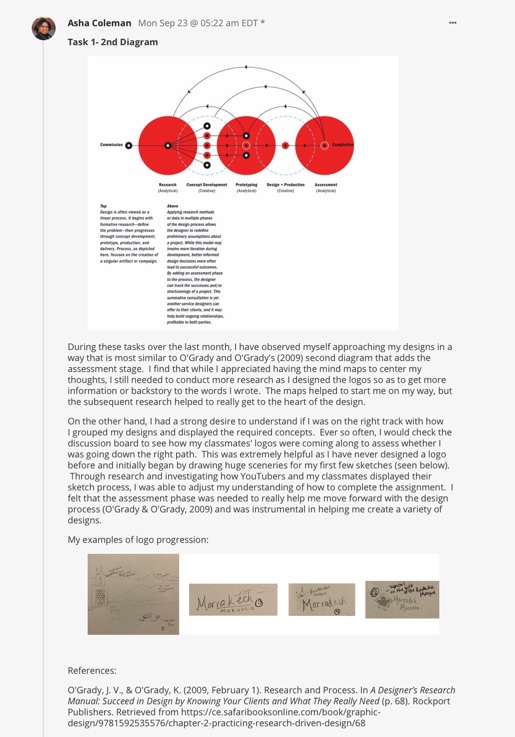
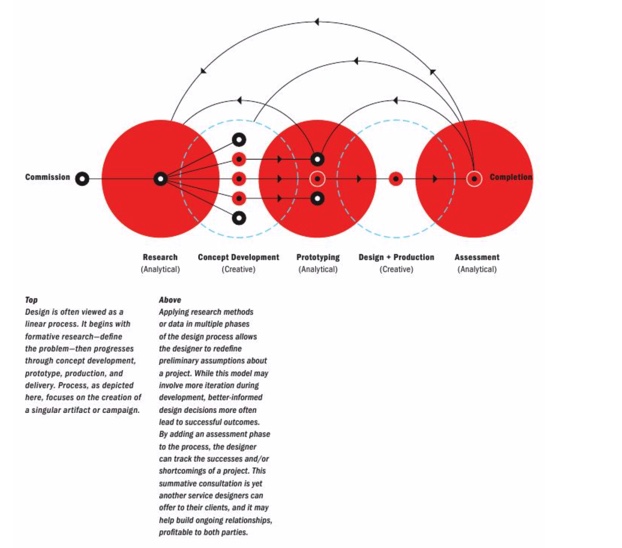
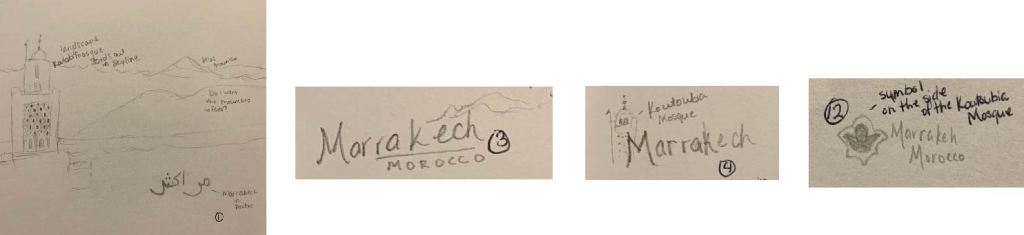
Interestingly, it seems that the process in the second diagram was shared amongst a few of my classmates, as well. I believe this process helps me to really solidify my ideas and as a researcher it’s like finding a resource to support your approach to the design. This may be why I appreciate critiques from others. It is helpful for me to know if I’m headed in the right direction before I get down to the finish line and realize I missed something entirely.
The critiques I received this month were instrumental in opening my eyes to what was working and what wasn’t working for my designs. I have started to understand more of what is meant when referring to keeping it simple or making it relevant as Airey’s 7 principles of logo design reference (as noted in McClung, n.d.). My next task will be to choose three logos from each category (geography, culture, and traditions) to revise for my final task. The critiques I have recieved from my classmates and the information I have learned, along with constant assessment, will help guide me through this process.
References:
McClung, R. (n.d.). MDM525 Week 3 Live Session. Retrieved from https://online.fullsail.edu/class_sections/46723/modules/182645/activities/1139434
O’Grady, J. V., & O’Grady, K. (2009, February 1). Research and Process. In A Designer’s Research Manual: Succeed in Design by Knowing Your Clients and What They Really Need (p. 68). Rockport Publishers. Retrieved from https://ce.safaribooksonline.com/book/graphic-design/9781592535576/chapter-2-practicing-research-driven-design/68


One thought on “Still Month 2: Defining Client Needs Post”