Do I write right?!
In the beginning of this course, I was extremely intimidated by the idea of writing copy. While I’ve written thesis before, writing academically for most of my life versus writing creatively for a month was no small task, to say the least. I do enjoy writing so I was excited to break out my academic bondages, but then the assignments came.
My process
This month we explored the wonderful world of copy. Using Felton’s (2013) Advertising: Concept and Copy as the textbook, we researched effective tips and processes used to develop leading copy used in advertising today. Felton’s (2013) step-by-guidance and principles for writing copy helped alleviate some of the fear I was building up about how to come up with concepts. His use of real-world examples also helped support his approach and the load of new information of new informatiton I was taking in.
In addition, we also used Craig Smallish’s (2013; 2014) Lynda.com courses. These courses helped me learn practical approaches to putting together presentations and final product ads for clients as well as the theory behind the practice. It was especially helpful having a Smallish’s (2014) video on “Preparing the presentation” as I was trying to turn in finished testimonial ads rather than mockups for my Week 2 Mastery project. With help from my classmate (Thanks, Vontresia!!) and this course, I was able to finish the project appropriately. So here’s how everything turned out.
My Target Audience and Personas
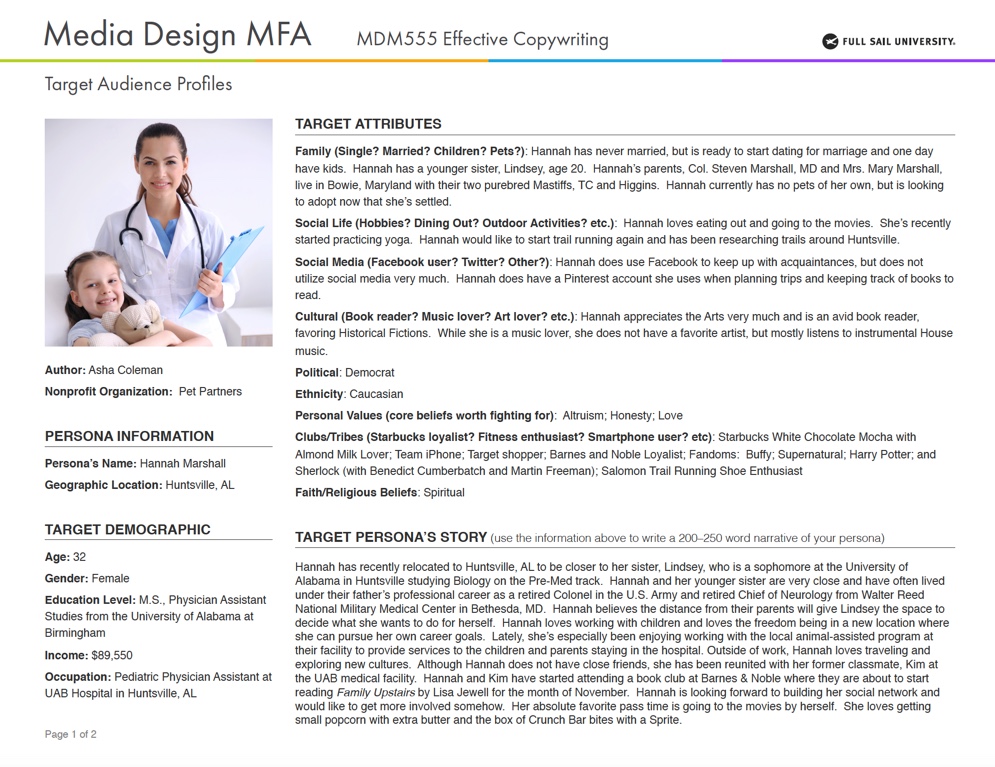
When creating these personas, the goal was to target an audience between the ages of 25-50. It just so happened that Hannah became a 36 year-old, single, Pediatric Physician Assistant who recently relocated to Huntsville, AL to be near her sister. This persona developed into a young woman working in a hospital with children who could potentially benefit from Pet Partners’ services. Hannah’s profile was beneficial for this process because it represents someone who has all of the pieces, but has not connected the dots for pet therapy: wants a pet, works at a facility that could benefit from pet therapy, and looking to become more involved in her new area.
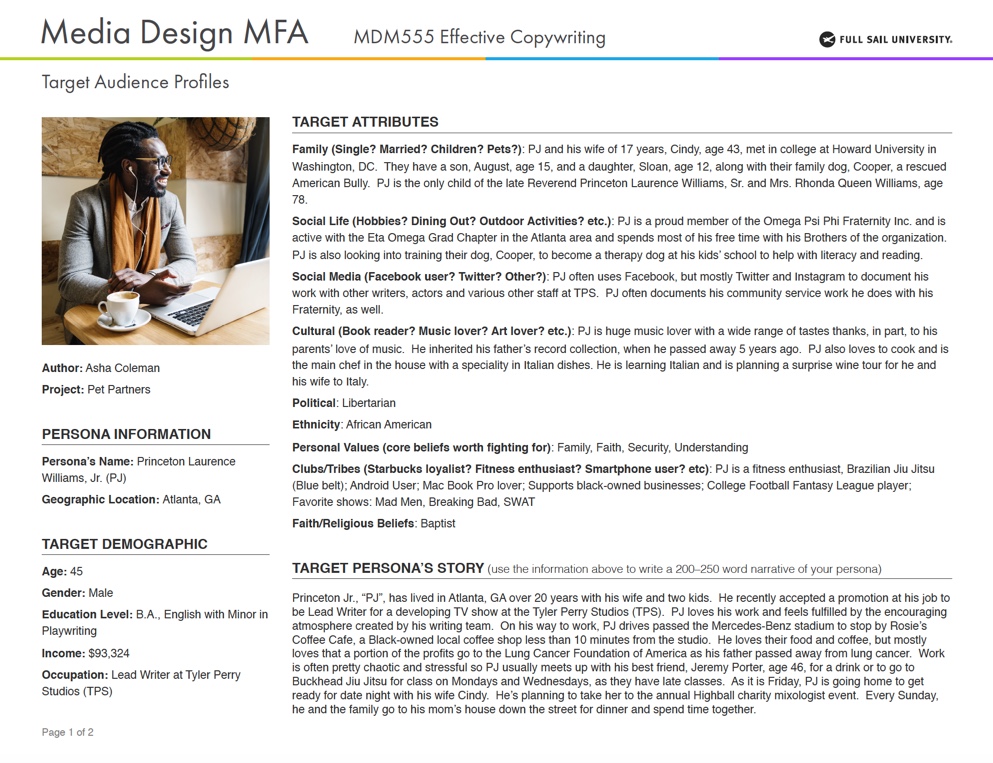
On the other hand, PJ was developed as someone who is specifically looking to get involved as a pet therapy volunteer at his kids’ school. His involvement in a Fraternity has already predisclosed him to volunteering his time. This persona is meant to represent those who know of pet therapy and work towards compelling them to take that extra step toward making this committment. Using the information collected from these two personas, I developed my first six sketches of the testimonial ads.
The Testimonial sketches
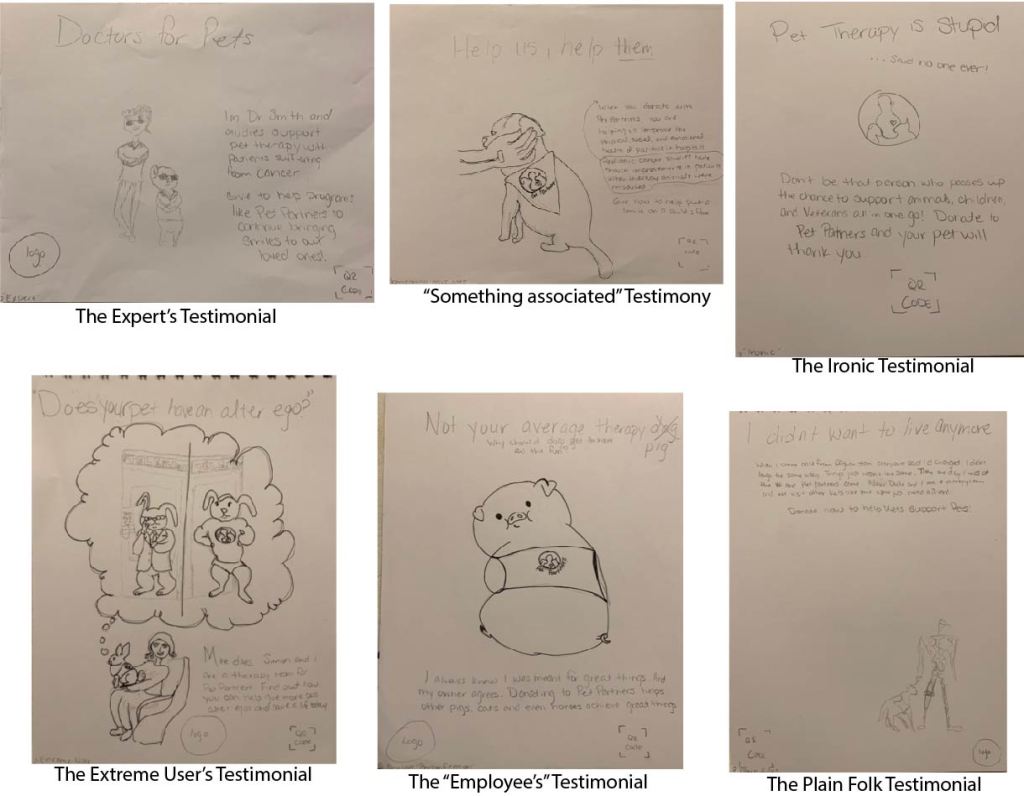
So this is the assignment that gave me a good bit of trouble as I was attempting to create finished testimonials to turn in when I needed to just draft mockups. However, as Smallish (2014) stated, it’s best to get the ads as close to being done as possible so the client has a good idea of what the finished product looks like, but there is still room for editing and exploration.
I chose these six as my testimonial ads because they allowed for the most creativity and exploration on how the copy could be represented. Testimonials like Felton’s (2013) Extreme User, the Ironic and the “Employee’s” testimonial allowed me to use a fun and lighthearted approach to the ad while the use of the Expert, Something associated and the Plain Folk testimonial were more serious. I wanted to explore different ways the copy could convey its overall message to inspire someone to either donate to Pet Partners or even become a pet therapy volunteer.
My Initial and Final Comps
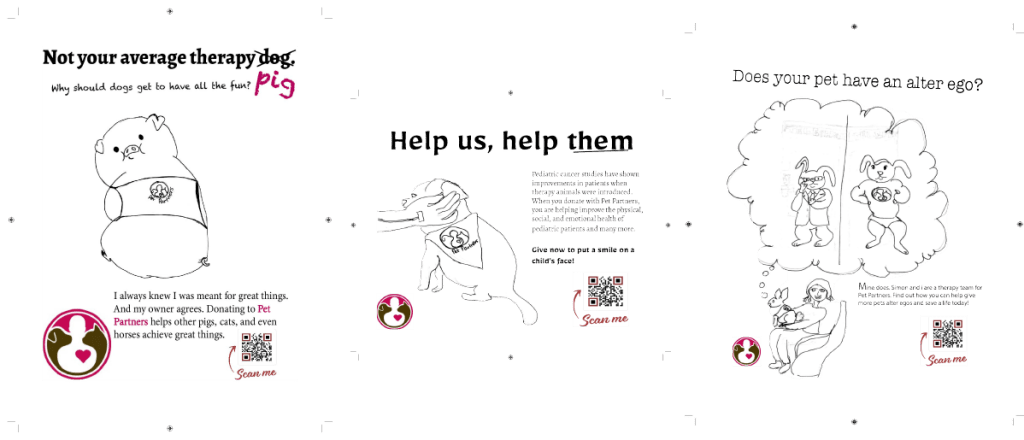
The initial comps were incredibly difficult to cultivate as I was unsure about what I was doing and whether I was doing it right. With much needed encouragment from my husband and peers, I continued working on the copy of the testimonials until I felt it portrayed the message I was trying to convey. When developing these particular testimonials, I remember the headlines would come to me and the imagery would immediately follow. I thought about my personas, Hannah and PJ, looking through a magazine or walking by a billboard in their coffee shop and one of these sticking out to them. I think that’s how I chose to pursue these three comps. The body copy was a little more awkward to write, as I had to think of how to continue keeping the audience’s attention while also speaking through another voice and staying authentic to the message. Also, the QR codes were my own little nod to finally understanding what a QR code is for!
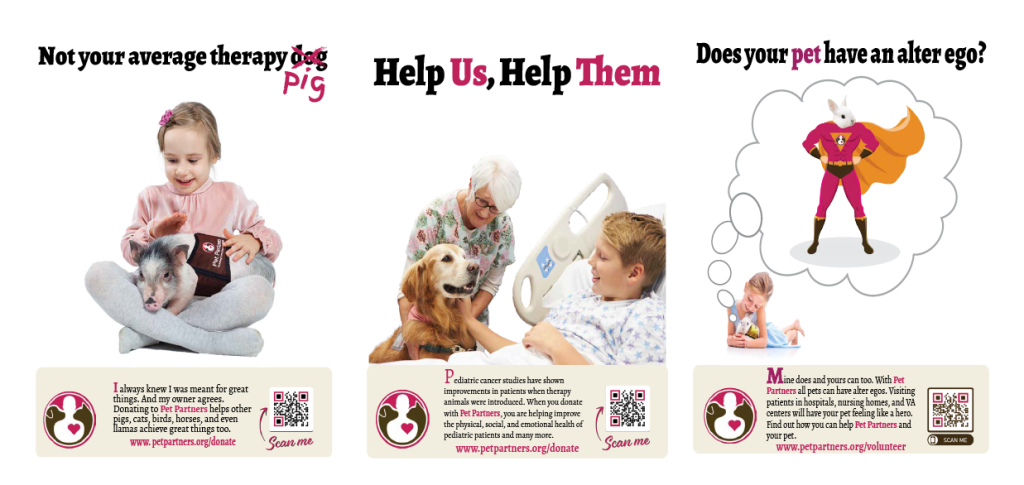
After receiving feedback that the comps needed to all be vertical as well as cohesive, I set out to find ways to improve my testimonials. Initially, I thought about creating the Therapy Pig testimonial with some of the other types of animals Pet Partners has for volunteers. However, I wanted to challenge myself to use the ads I already developed and make each of these different testimonials cohesive. Using the same layout, color palette, and type for each testimonial brought everything together. While I still need to work on my spacing and sizing to really solifidy a cohesive look, the effect of the goal was achieved.
And so, my takeaways
- Copywriting is frustrating, fun, and oddly satisfying all wrapped up in one confusing ball. If you ever think you aren’t doing it right, you’re probably just working on your next project.
- The greatest copy writers copy (Felton, 2013; Horberry, 2009). Don’t try to reinvent the wheel, just make it look fancier.
- Even when you think you’re done with the copy, there’s a good chance you’ll wake up in the middle of the night with an even better idea after it’s already gone to print. So, once it’s done, let it go.
References:
Adams, D. (2011, February 14). What is copywriting and how is it important for a designer? [Online article]. Retrieved from http://www.instantshift.com/2011/02/14/what-is-copywriting-and-how-is-it-important-for-a-designer/
Felton, G. (2013). Advertising: Concept and Copy, 3rd Edition [VitalSource Bookshelf version]. Retrieved from vbk://9780393733921
Horberry, R. (2009). Brilliant copywriting. Harlow, Great Britain: Pearson Education Limited. Retrieved from https://ce.safaribooksonline.com/book/communications/writing/9780273727347
Smallish, C. (2013, August 16). Developing ideas and design concepts [Lynda.com course]. Retrieved from https://www.lynda.com/Design-Business-tutorials/Developing-Ideas-Design-Concepts/126121-2.html?org=fullsailold.edu
Smallish, C. (2014, May 27). Designing a print ad [Lynda.com course]. Retrieved from https://www.lynda.com/Design-Page-Layout-tutorials/Designing-Print-Ad/155264-2.html?org=fullsailold.edu


One thought on “Month 4: Reflection of Effective Copywriting”