So here I am, over half way through with this one year program and I’m feeling very motivated to beef up my design experience outside of my program. I have been applying to internships, talking to other professionals in the field and taking on side projects like creating cover art for a local artist. While Design Strategies and Motivation is really focused on the motivations of our consumers, I think it can be seen as motivation for the designers as well. One thing I can say I’ve learned during this month is that if you have a strategy and better understanding of what your client is looking for, it is a hell of a lot easier to design something for them.
So I’m excited because not only am I designing my first non school-related project, but it’s my first time collaborating with someone, professionally. On the other hand, I have officially created a restaurant concept for our most recent school project that was right up my alley! We each created a design strategy for a sushi restaurant based in East Side Milwaukee named BoxPark Sushi. Let’s just say, I ate this assignment up. *puns are 99.9% always intended*
Overview of the material and concepts learned this month
Connecting/Synthesizing/Transforming
Understanding that design strategy is akin to the business strategy is a key piece of explaining how we as designers contribute to the conversation (Rosebrook, n.d.). In they’re article, Rosebrook (n.d.) commented that once we learn the driving metrics from a company’s sales and numbers, we create the visual design to solve for it. So to do this, we began the month learning about what goes into creating a design strategy or in Felton’s (2013) case, an advertising strategy.
Felton’s (2013) suggestion for creating a strategy is to first understand what your client is selling. For our assignment, this meant becoming more familiar with sushi, itself. Not just go eat sushi from your local restaurant or pick it up at the grocery store. We needed to become a student of sushi so that meant learning about its history, terminology, and if possible, learning to make authentic sushi.
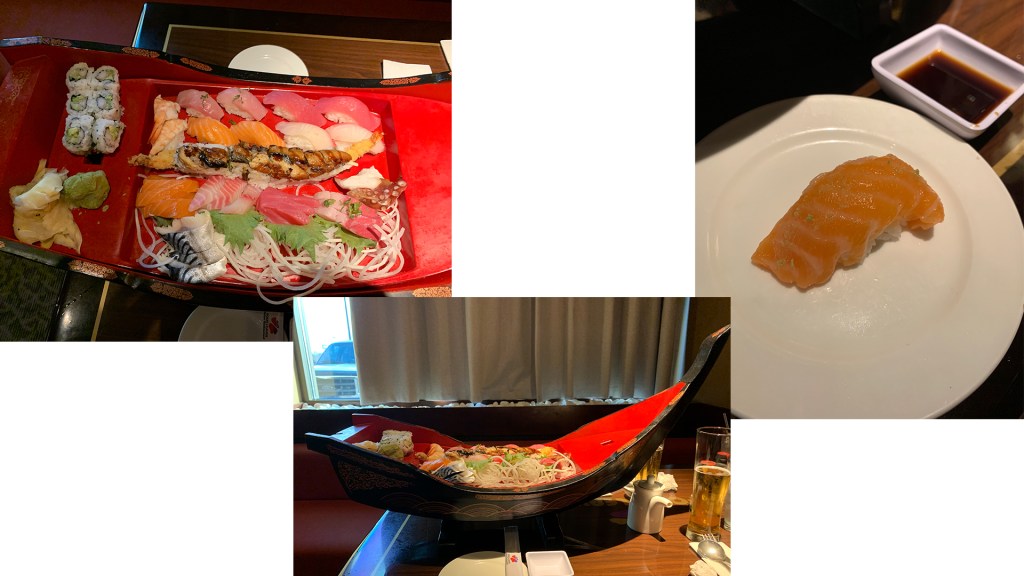
Well, seeing as how I didn’t exactly have time to make sushi, we decided to go for a nice dinner instead. One sushi and sashimi boat dinner later and I had just finished one of the best homework assignments I’d ever experienced. Until I learned that pretty much nothing on my boat is considered authentic sushi.
Here’s where becoming a student of the product was essential. First of all, traditional sushi involves the nori (seaweed) being wrapped around rice typically with a piece of fish or seafood in the middle (Hill, 2009). What we often eat when we go to sushi restaurants is the modernized, American version of sushi (Sakamoto & Allen, 2011). So all those California Rolls and Dragon Rolls may not be on the menu if you go to Japan (if it is then you might survive your trip).
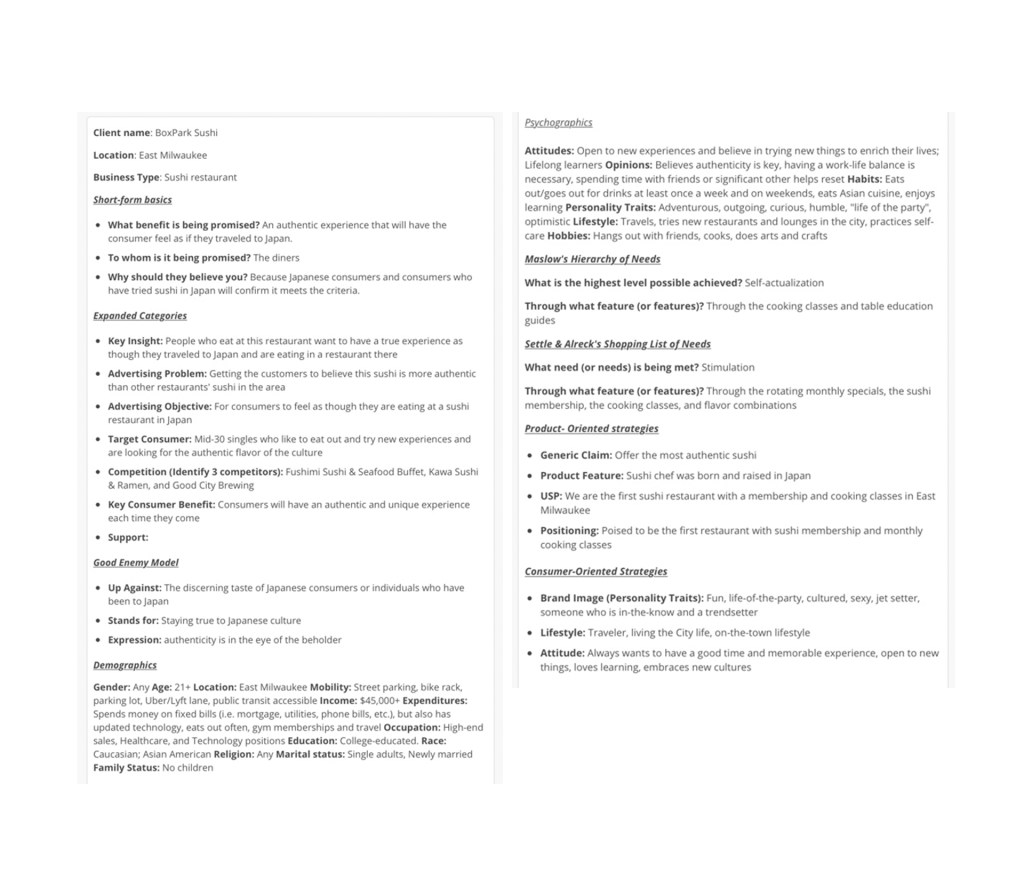
Using this information, we then moved on to thinking about our consumers’ behaviors and how our sushi restaurant can address their needs. Being able to take what I learned about sushi and people’s thoughts about it, helped me to build an introductory concept of what kind of sushi restaurant I wanted to develop. Combining this learning with the development of consumer’s needs following Maslow’s Hierarchy of Needs and Settle & Alreck’s Shopping List of Needs (as noted in Felton, 2013) helped identify specific ways the restaurant will satisfy the consumer. Taking these into consideration, the designer can then begin to identify the demographics and psychographics to create a clearer picture of the target group (Chi, 2019; Shaw, 2018).
Identifying the not only who my target is but they’re behaviors can help develop my strategy to either be consumer-oriented or product-oriented (Felton, 2013). There are arguments in favor of consumer-oriented strategies such as Ogilvy’s belief that correctly placing your product in the consumer’s lifestyle, focusing on the brand’s image and the voice or attitude are what set the brand apart from others (as noted in Felton, 2013). While on the other hand, there are arguments in favor of product-oriented strategies that allow the brand to focus on setting itself apart focusing on the product and not the consumers’ every need because almost every brand is focused on meeting consumers’ needs (Ries, 2016). Both, Ries (2016) and Favat (2015) make a key observation that even when a brand meets the consumers’ identified needs of a product, the consumer still may continue to buy other brands showing that there is no guarantee that being consumer-oriented equals success.
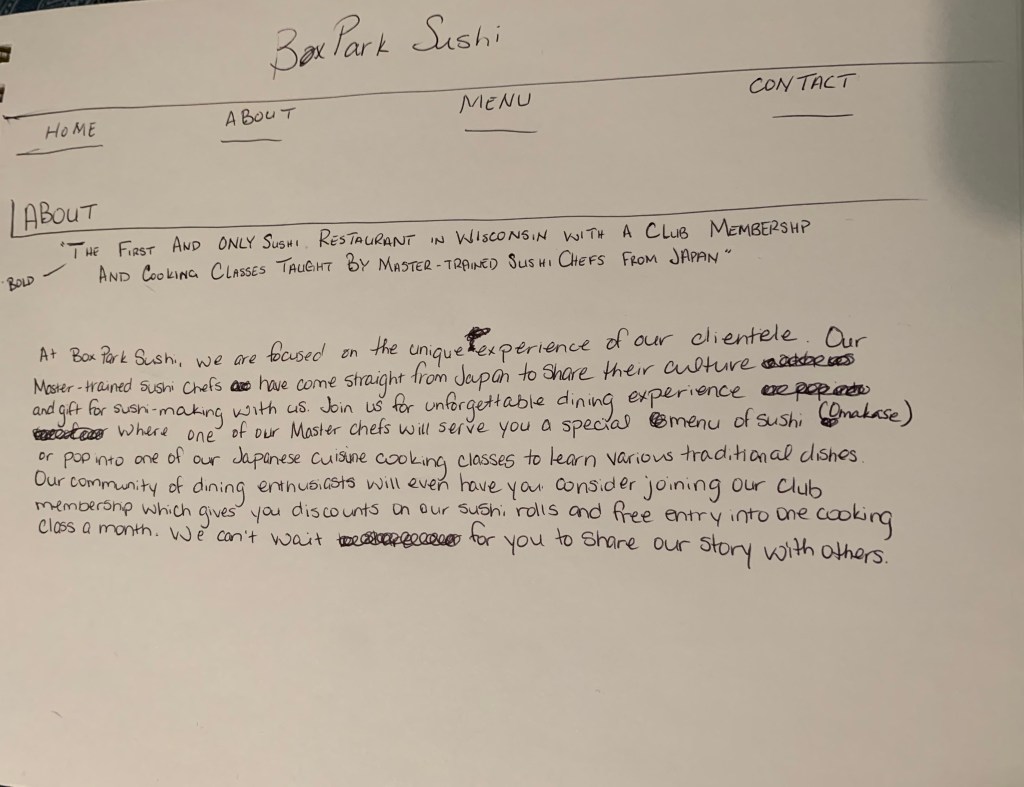
So for the sake of my BoxPark Sushi restaurant, I decided to take the consumer-oriented strategy focusing on inserting this authentic sushi experience into the lifestyle of my consumers through extended happy hours, an adult hangout/ date night atmosphere, and learning environment for those who want to have new experiences. This did not keep me from considering the benefits of the product-oriented strategy such as BoxPark Sushi being the first and only restaurant in the state of Wisconsin with a Sushi Club membership and cooking classes. Just because I will have a consumer-focused campaign does not mean I won’t have advertisements focused on the products.
“When you’re making ads, use the idea of categories, but don’t be bound by it. Don’t worry over which you’re using so much as this: Is what you’re doing working?
(Felton, 2013, p. 45)
Ultimately, determining what strategy to take for the time being helped develop my creative brief. The creative brief is the guide that helps facilitate conversations moving from the strategy phase to the execution phase (Felton, 2013). For this creative brief, I tried to focus only on the authentic experience I wanted consumers to have and hoped to maintain that focus throughout the brief. Every element from the beginning of the course to the final assignment, helped develop this creative brief that will create the brand BoxPark Sushi.
Problem Solving
When completing the Hierarchy of Needs and the Shopping List of Needs (as noted in Felton, 2013), I struggled with how to create a realistic restaurant that met each need. It was difficult not to get carried away with the gimmicks that restaurants sometimes come up with to stay relevant. At the time of creating the lists I ended up doing exactly that. I focused on every gimmick I could think of to meet Maslow’s Hierarchy of Needs and Settle & Alreck’s Shopping List of Needs (as noted in Felton, 2013).
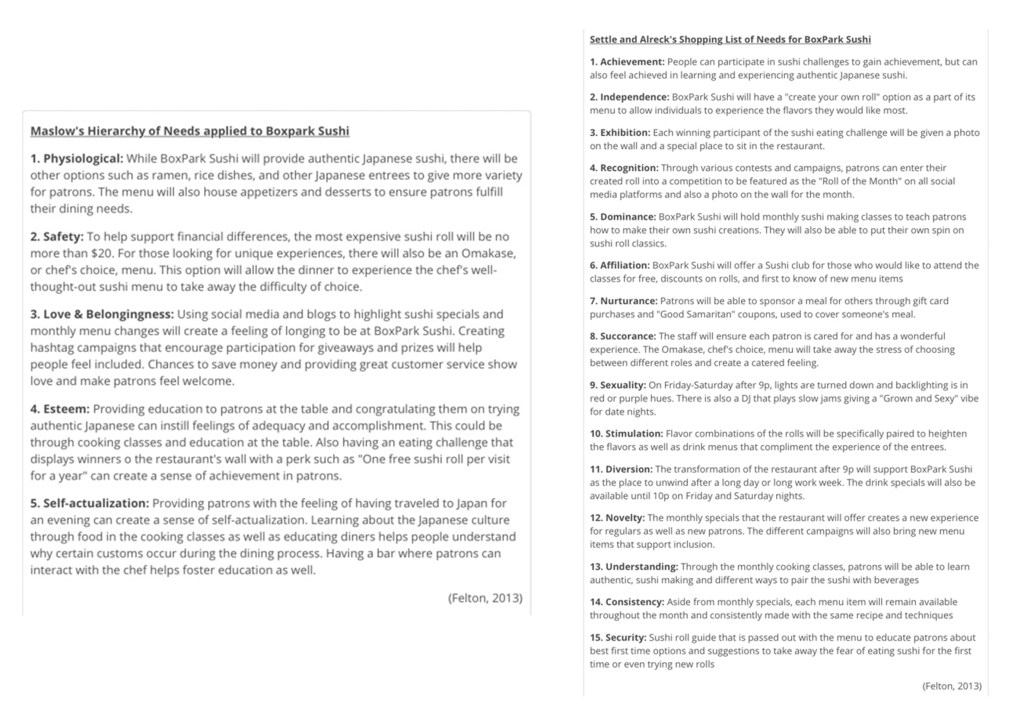
Later, I thought about how this could become overwhelming and take away from the unique quality of the restaurant. I was overloading the uniqueness of the restaurant to the point it would begin to mock the culture rather than celebrate the experience. So in the final creative brief, I chose to focus only on the experience of learning about the sushi and creating a Shogun-style restaurant where consumers sat right in front of the renowned chef born and trained in Japan who would hand-make each piece and place it before you. This intimate, Omakase (chef’s choice) meal would be unique enough without having a sushi eating challenge or a name your own sushi roll competition. Imagine what that would be like to sit across from a Master trained sushi chef and be educated on the subtle notes of the sushi as if you were at a wine tasting. This was the solution I decided would make my design strategy work.
Innovative Thinking
To highlight innovative thinking, I wanted to make sure I focused on the Shogun-style, Omakase (Chef’s choice) option of BoxPark Sushi, but also that my restaurant would have a Sushi Club membership as well as offer Japanese cuisine cooking classes. Essentially, my Unique Selling Proposition (USP) would be as the first and only Sushi Restaurant in Wisconsin with a club membership and cooking classes taught by Master trained Sushi Chefs from Japan. Too long? Maybe but it definitely sets my restaurant apart from the others in East Side Milwaukee.
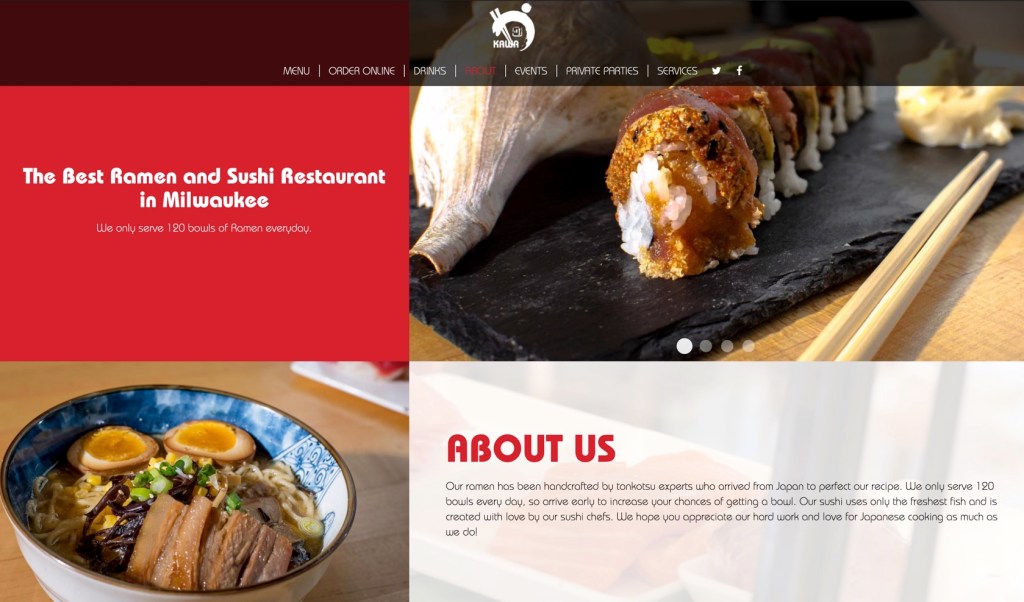
In the case of Kawa Ramen and Sushi, they focus on the generic claim of having the best ramen and sushi, but also provide a sense of urgency to try their ramen because they “only serve 120 bowls of Ramen everyday”. This is definitely an interesting approach, but my focus would be on creating a learning environment for diners would want to try new things and experience another culture in their own city. My approach can turn consumers into regulars. Creating a community with this restaurant is what sets BoxPark Sushi apart from the industry standard restaurants like Kawa Ramen & Sushi.
Acquiring Competencies
Academic
- Design strategy (technical): This was an essential tool for learning to develop a concept from start to execution. While I do believe this strategy will be used in occupational settings, it will help me organize future projects in this program, as well
- Consumer-oriented strategy (conceptual): This strategy focuses on how the designer can help steer the project to strengthen the brand’s image, help consumers associate the brand or its product into their lifestyle and devlope the voice or attitude of the brand
- Product-oriented strategy (conceptual): Understanding that this strategy is geared more toward setting the brand apart by focusing on positioning, the USP, and the generic claim helps the designer know how to strategize
- Maslow’s Hierarchy of Needs (technical): Being able to clarify the ways in which a business or product will meet the basic needs of a consumer will help the designer direct their visual solution to solve the problem
- Settle & Alreck’s Shopping List of Needs (technical): While this shopping list goes beyond basic human needs, it speaks to the needs we as humans crave to make life enjoyable and that is why it is important for the designer to be able to identify them
- Creative brief (conceptual): Completing our catch-all version of the creative brief was helpful in identifying the different ways a client may want to identify the goals of the project
Occupational
- Creative brief (technical): Being able to develop a brief that clearly identifies the strategy for the client will be an essential first step to devloping a brand’s identity
- Design strategy (technical): While I do have it listed above, I believe the design strategy is definitely a technical skill that will benefit the designer on-the-job as you will actually need to be able to put a strategy together when asked
- Market segmentation (conceptual): Understanding the importance of specifying the target and their behaviors helps focus the benefits and features of the product
- Demographics (technical): Having the ability to collect the data needed to make up the demographics of a target is going to be an essential research skill in a job
- Psychographics (technical): Also, having the insight needed to find the consumers’ behaviors and motivation for purchases is essential to really getting into the heart of the consumer and why they may or may not buy your product
- Consumer behaviors (conceptual): This is under the occupational list because my future goal is further my Psychology education focusing on what motivates consumers to buy certain products over others. How does our focus on this behavior drive or hinder consumer decisions?
References:
Chi, C. (2019, October 3). What Is demographic segmentation, & how do you do it?. HubSpot. https://blog.hubspot.com/marketing/demographic-segmentation
Felton, G. (2013). Advertising: Concept and Copy, 3rd Edition [VitalSource eBook version]. vbk://9780393733921
Hill, K. (2009, December 3). What exactly is sushi?. Kitchn. https://www.thekitchn.com/what-exactly-is-sushi-103062
Ries, A. (2016, May 09). Being customer oriented isn’t the best marketing strategy. AdAge. https://adage.com/article/al-ries/customer-oriented-marketing-strategy/303913
Rosebrook, D. (n.d.). What is Design Strategy?: Why we need to opt for a more professional process. Marvel. https://blog.marvelapp.com/what-is-design-strategy/
Sakamoto, R. & Allen, M. There’s something fishy about that sushi: How Japan interprets the global sushi boom. Japan Forum, 23(1), 99-121. Retrieved February 8, 2020 from http://web.b.ebscohost.com.oclc.fullsail.edu:81/ehost/pdfviewer/pdfviewer?vid=4&sid=09a868e5-9e3a-4d95-a064-db9d823f4fbc%40pdc-v-sessmgr05
Shaw, A. (2018, May 10). Psychographic segmentation definition with examples. Marketing Tutor. https://www.marketingtutor.net/psychographic-segmentation-definition-examples/

